
What Is Stated Value Car Insurance? Understanding Your Vehicle's Coverage
If you own a classic car, a restored muscle car, or a heavily modified vehicle, choosing the right insurance coverage can be more complicated than insuring an everyday driver.
One term you may encounter is stated value car insurance. At first glance, it sounds straightforward: you tell the insurance company what your vehicle is worth, and that's the amount you're insured for.
But there's an important catch. With many stated value policies, the amount you declare isn't necessarily what you'll receive if your car is stolen or declared a total loss.
Understanding how stated value works and how it differs from agreed value and actual cash value can help you avoid unpleasant surprises when filing a claim.
What Does Stated Value Car Insurance Mean?
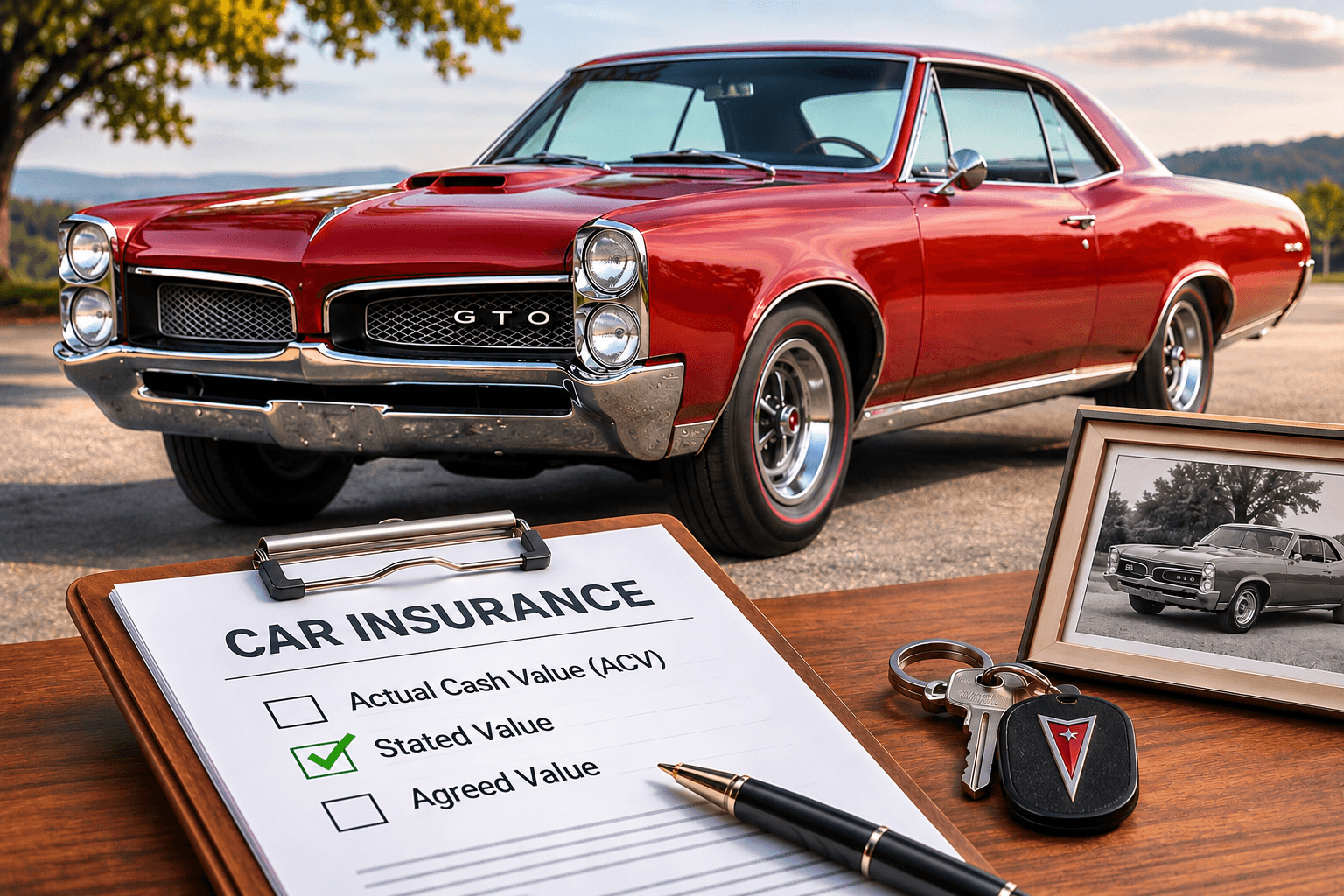
Stated value insurance allows a vehicle owner to declare a specific value for a car when purchasing coverage.
For example, you might insure a restored 1967 Pontiac GTO with a stated value of $75,000. That figure may be based on an appraisal, restoration records, comparable vehicle sales, or an estimate of the car's current market value.
However, the stated value is not automatically a guaranteed payout.
Under many stated amount policy endorsements, the insurer pays the lesser of the stated amount or the vehicle's actual cash value at the time of the loss, subject to the policy's terms, deductible, and applicable limits.
That means if the car's actual cash value is determined to be $60,000 when it is totaled, the insurer may pay $60,000 rather than the $75,000 stated on the policy.
The exact settlement depends on the insurance contract, so it's essential to read the valuation and loss-settlement provisions carefully.
Stated Value vs. Actual Cash Value vs. Agreed Value
These three insurance terms are often confused, but they can lead to very different outcomes after a total loss.
Actual Cash Value (ACV)
Actual cash value coverage is common for standard passenger vehicles.
If your car is stolen and not recovered or is declared a total loss, the insurer determines its value immediately before the loss.
The valuation may consider the vehicle's age, mileage, condition, equipment, comparable sales, and local market conditions.
Unlike a fixed insured value, actual cash value can change over time. It may decrease as a vehicle ages, although some collector vehicles can appreciate.
Stated Value Insurance
With stated value coverage, the policyholder declares a value for the vehicle when arranging insurance.
That amount generally serves as a limit rather than a guaranteed settlement figure under common stated amount endorsements.
The insurer may still determine the vehicle's actual cash value at the time of the loss and pay the lesser amount.
This distinction can be especially important for vehicles that have appreciated or undergone extensive restoration.
Agreed Value Insurance
Agreed value insurance, sometimes called guaranteed value coverage, works differently.
The owner and insurer agree on the vehicle's insured value when the policy is issued or renewed.
Under a genuine agreed value policy, a covered total loss is generally settled using that agreed amount, subject to the policy's terms and any applicable deductible.
For many classic and collector car owners, agreed value coverage offers greater predictability because the insured value is established in advance rather than being determined after a loss.
However, not every policy marketed to collector car owners uses the same wording. Always confirm how the contract defines the payout.
How Much Would You Receive After a Total Loss?
Consider a classic car with the following values:
- Stated value on the insurance policy: $80,000
- Actual cash value at the time of loss: $65,000
- Agreed value under a separate policy: $80,000
If the vehicle is declared a covered total loss, the settlement could look like this:
| Type of coverage | Illustrative settlement before deductible |
| Actual cash value | $65,000 |
| Stated value | $65,000, under a lesser-of provision |
| Agreed value | $80,000 |
This example assumes the policy covers the loss and there are no other adjustments, exclusions, or limits affecting payment.
The difference illustrates why a stated value of $80,000 should not be mistaken for a promise to pay $80,000.
How Do Insurance Companies Determine a Vehicle's Value?
Insurance companies use several sources of information to evaluate a vehicle's worth.
For an everyday car, this may include market data, comparable vehicle listings and sales, mileage, condition, equipment, and vehicle history.
For a classic or specialty vehicle, the process can be more complicated.
An insurer may need to consider:
- Make, model, year, and production rarity
- Originality and matching-numbers components
- Overall mechanical and cosmetic condition
- Restoration quality and documented expenses
- Factory options and special equipment
- Modifications and custom work
- Comparable sales of similar vehicles
- Ownership history and provenance
A rare collector car cannot always be valued accurately using the same methods applied to a typical used vehicle.
For example, two 1967 Pontiac GTOs may look nearly identical but have substantially different values because of their engines, factory options, authenticity, and restoration histories.
Why Is a Professional Vehicle Appraisal Important?
A professional appraisal provides an independent, documented assessment of a vehicle's value at a particular point in time.
For owners arranging stated value or agreed value insurance, an appraisal can help establish a reasonable insured amount and provide supporting documentation to the insurer.
A detailed appraisal may include photographs, condition assessments, vehicle identification information, equipment descriptions, market comparisons, and an explanation of the valuation.
It can also be useful if a claim is disputed, although an appraisal does not override the terms of an insurance contract or guarantee a particular settlement.
For classic and collector vehicles, keeping an appraisal current is especially important. Market values can change, and major restoration work or modifications may affect what a vehicle is worth.
Is Stated Value Insurance Right for a Classic Car?
Stated value insurance may be appropriate in certain circumstances, particularly when a vehicle is unusual or difficult to value using standard insurance methods.
However, it is not necessarily the best choice for every collector car.
If your primary concern is receiving a predetermined amount after a covered total loss, an agreed value policy may be more suitable.
Before purchasing coverage, ask your insurer:
- Is the stated amount a guaranteed payout or only a policy limit?
- Will a total-loss claim be settled using actual cash value?
- Is an independent appraisal required?
- How are restoration work and modifications treated?
- Are there mileage, storage, driver, or vehicle-use restrictions?
- Can the insured value be updated if the car appreciates?
The answers can help you understand what you're actually buying.
Protecting the Value of Your Classic or Collector Car
Owning a collectible vehicle is different from owning an everyday car. Its value may depend on rarity, condition, originality, restoration quality, and historical significance rather than age and mileage alone.
That's why choosing insurance based solely on the amount shown on a policy can be risky.
Whether you're considering stated value or agreed value coverage, the first step is understanding what your vehicle is worth and how your insurer will handle a total-loss claim.
Need to Establish Your Vehicle's Value?
Auto Appraisal Network provides professional vehicle appraisal services for classic cars, collector vehicles, custom builds, and other specialty automobiles.
A documented appraisal can help you understand your vehicle's current market value and provide useful information when discussing insurance coverage with your provider.
Learn more about Auto Appraisal Network's vehicle appraisal services.
