
The Fastest Car on Earth
How ThrustSSC Broke the Sound Barrier at 763 MPH
Imagine driving a car so fast that it creates a sonic boom. Not on a racetrack, but across a vast stretch of desert, with two jet engines roaring behind you.
That's exactly what British Royal Air Force pilot Andy Green accomplished on October 15, 1997, when he drove ThrustSSC to an official world land speed record of 763.035 mph (1,227.985 km/h) at Nevada's Black Rock Desert.
Nearly three decades later, that record still stands. ThrustSSC remains the fastest officially recognized land vehicle in history and the first to achieve a verified supersonic land speed record.
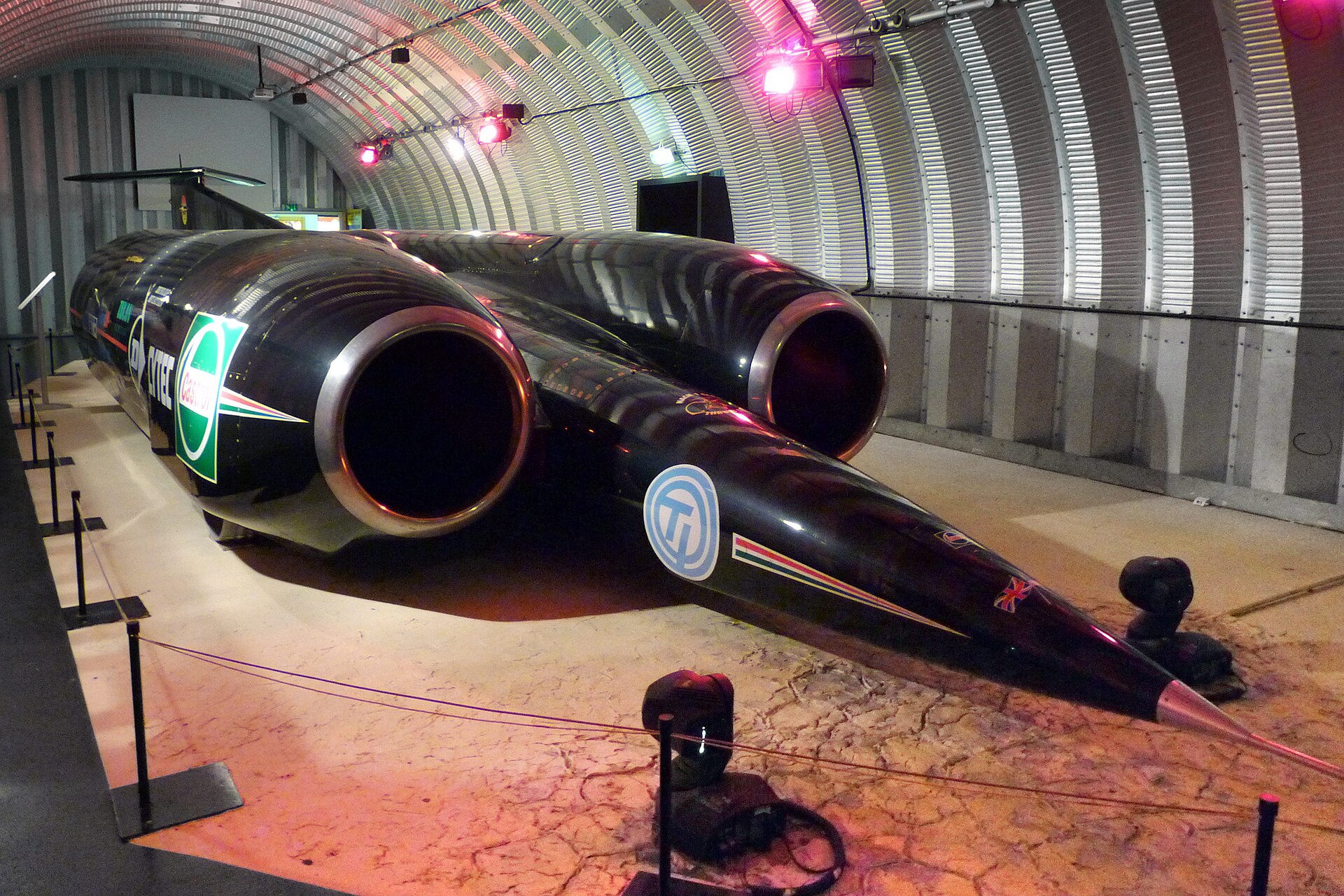
Photo by Cmglee - Own work, CC BY-SA 3.0, commons.wikimedia.org/w/index.php?curid=16857264
What Is ThrustSSC?
ThrustSSC, short for Thrust Supersonic Car, was a British engineering project developed with one extraordinary goal: to break the sound barrier on land.
The project was led by Richard Noble, who had already made history in 1983 by setting a land speed record of 633.468 mph in Thrust2.
But reaching the speed of sound required an entirely different kind of vehicle.
Designed by a team that included aerodynamicist Ron Ayers and engineer Glynne Bowsher, ThrustSSC looked more like a military aircraft without wings than a conventional automobile.
Its long, narrow body, twin jet engines, and unusual wheel arrangement were designed to keep the vehicle stable at speeds no officially recognized land vehicle had ever achieved.
Two Jet Engines and 50,000 Pounds of Thrust
Forget horsepower figures for a moment. ThrustSSC wasn't powered by a conventional automotive engine.
Instead, it used two Rolls-Royce Spey turbofan engines derived from those installed in British Phantom fighter aircraft.
Together, the engines could produce approximately 50,000 pounds of thrust in their record-run configuration.
Unlike a traditional car, where engine power is transferred to the wheels through a transmission, ThrustSSC relied entirely on jet thrust to propel itself forward.
Its four wheels were not driven by the engines. They supported, steered, and stabilized the vehicle as it accelerated across the desert.
The engineering specifications were just as extraordinary as its performance:
- Engines: Two Rolls-Royce Spey turbofans
- Maximum combined thrust: Approximately 50,000 pounds-force
- Length: Approximately 54 feet (16.5 meters)
- Width: Approximately 12 feet (3.7 meters)
- Weight: Approximately 10.5 metric tonnes
- Fuel consumption: Approximately 4.8 US gallons (18 liters) per second at high power
- Official land speed record: 763.035 mph (1,227.985 km/h)
At full power, ThrustSSC could burn through hundreds of gallons of fuel in less than a minute.
But producing enough thrust was only part of the challenge. Keeping the car under control at supersonic speeds was an equally remarkable achievement.
October 15, 1997: The Day a Car Broke the Sound Barrier
The record attempt took place on the dry lakebed of Nevada's Black Rock Desert, where the team prepared a long, relatively flat course.
Andy Green, an experienced RAF fighter pilot, was selected to drive the car.
To establish an official land speed record, the team needed to complete two timed runs in opposite directions within a specified period. The average speed over the measured distance would determine the record.
On October 15, Green completed both runs, breaking the sound barrier and producing sonic booms that could be heard miles away.
The official average speed was 763.035 mph, approximately Mach 1.02 under the atmospheric conditions that day.
That was faster than the speed of sound.
It was also an extraordinary moment in motorsports history, occurring almost exactly 50 years after Chuck Yeager's first officially recognized supersonic flight in 1947.
Why Was Breaking the Sound Barrier So Difficult?
Driving at 763 mph involves challenges that ordinary performance cars never encounter.
As a vehicle approaches the speed of sound, airflow around its body changes dramatically. Shock waves form, aerodynamic forces become more complicated, and even small stability problems can have serious consequences.
ThrustSSC required specialized engineering to manage those forces.
Its wheels were made from solid metal rather than conventional rubber tires, which would not have survived the enormous rotational speeds and loads.
The vehicle also used an unconventional rear-wheel steering arrangement, with the front wheels fixed in position and the rear wheels providing directional control.
During development, the team encountered serious handling difficulties. Testing in Jordan revealed instability that required further refinement before the record attempt could proceed.
By the time ThrustSSC reached Nevada, years of engineering, testing, and problem-solving had gone into making the record possible.
Is ThrustSSC Still the Fastest Car in the World?
Yes. As of November 2026, ThrustSSC still holds the FIA's outright world land speed record.
Other projects have attempted to challenge its achievement.
One of the most ambitious was Bloodhound LSR, another British jet-powered vehicle designed with the goal of eventually exceeding 1,000 mph.
During testing in South Africa in 2019, Bloodhound reached approximately 628 mph. Although impressive, that speed did not surpass ThrustSSC's official record.
It's also important to distinguish the outright land speed record from production car speed records.
The fastest road-legal production cars compete in a completely different category. ThrustSSC was a purpose-built jet-powered record vehicle, not a road car.
Where Is ThrustSSC Today?
ThrustSSC is preserved at the Coventry Transport Museum in Coventry, England.
The museum also houses Thrust2, the earlier record-breaking car driven by Richard Noble.
Together, the vehicles represent two remarkable chapters in British engineering and the history of land speed racing.
ThrustSSC is more than an unusually fast machine. It's a reminder of what can happen when ambitious engineering meets years of determination.
And until another vehicle officially surpasses 763.035 mph, the title of the fastest car on Earth still belongs to ThrustSSC.
